Draw No Bet (DNB) is one of the most misunderstood market types in sports betting. Bettors see it in football matchups, notice the odds are lower than 1X2, and often move on without fully grasping how the settlement mechanics work — or why the market exists in the first place.
This article explains everything: how Draw No Bet is structured, how odds are calculated from a 1X2 line, what happens to your stake when the match ends level, how DNB compares to Asian Handicap 0 and the standard three-way market, and where the market actually appears. No speculation, no profit guarantees — just a complete mechanical breakdown.
What Is Draw No Bet?
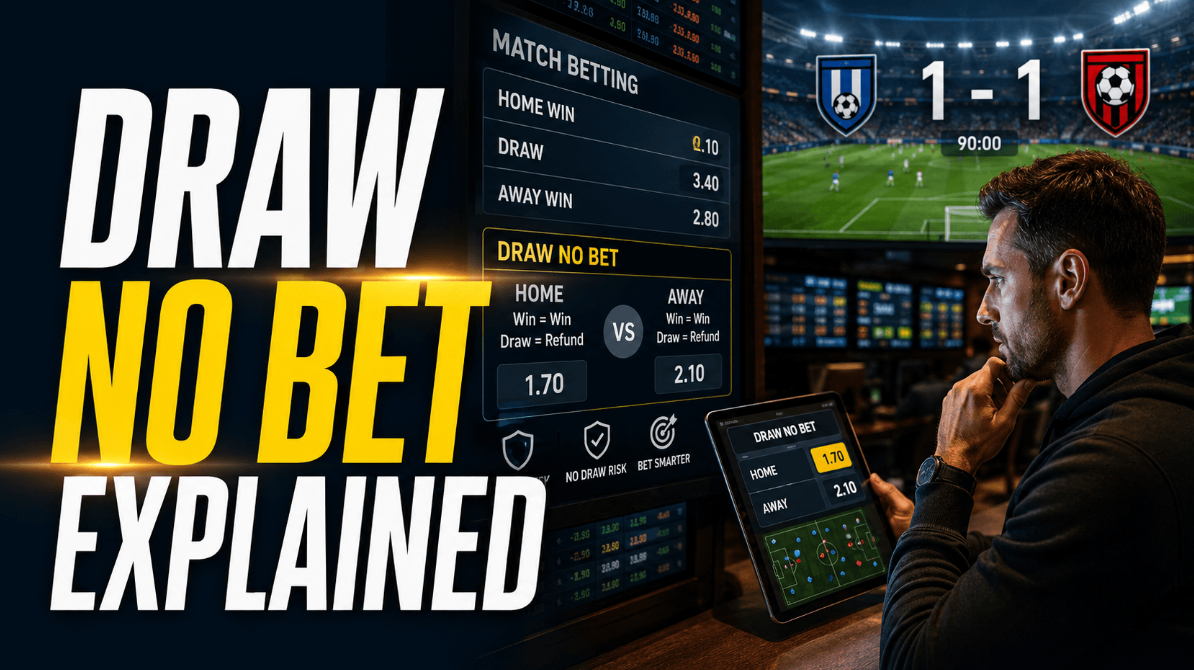
Draw No Bet is a two-outcome betting market in which the draw result is removed from the equation. You back either the home side or the away side. If your selection wins, the bet settles as a winner. If your selection loses, the bet loses. If the match ends in a draw, your entire stake is refunded, as though the bet never happened.
The term "Draw No Bet" is accurate in the literal sense: the draw outcome does not exist in this market. Bookmakers effectively remove it by splitting the stakes that would have been allocated to the X outcome across the two remaining selections, adjusting odds accordingly.
DNB does not eliminate risk. You can still lose the bet if your selection is defeated on the scoreline. It only provides insurance against the specific scenario of a drawn match.
How the Draw No Bet Market Is Structured
Available Outcomes in Draw No Bet
A DNB market contains exactly two options:
- DNB Home — your stake wins if the home team wins; stake is refunded if the match is a draw; stake is lost if the away team wins.
- DNB Away — your stake wins if the away team wins; stake is refunded if the match is a draw; stake is lost if the home team wins.
There is no third option. You cannot back the draw in a Draw No Bet market by definition.
What Happens to the Stake If the Match Ends in a Draw
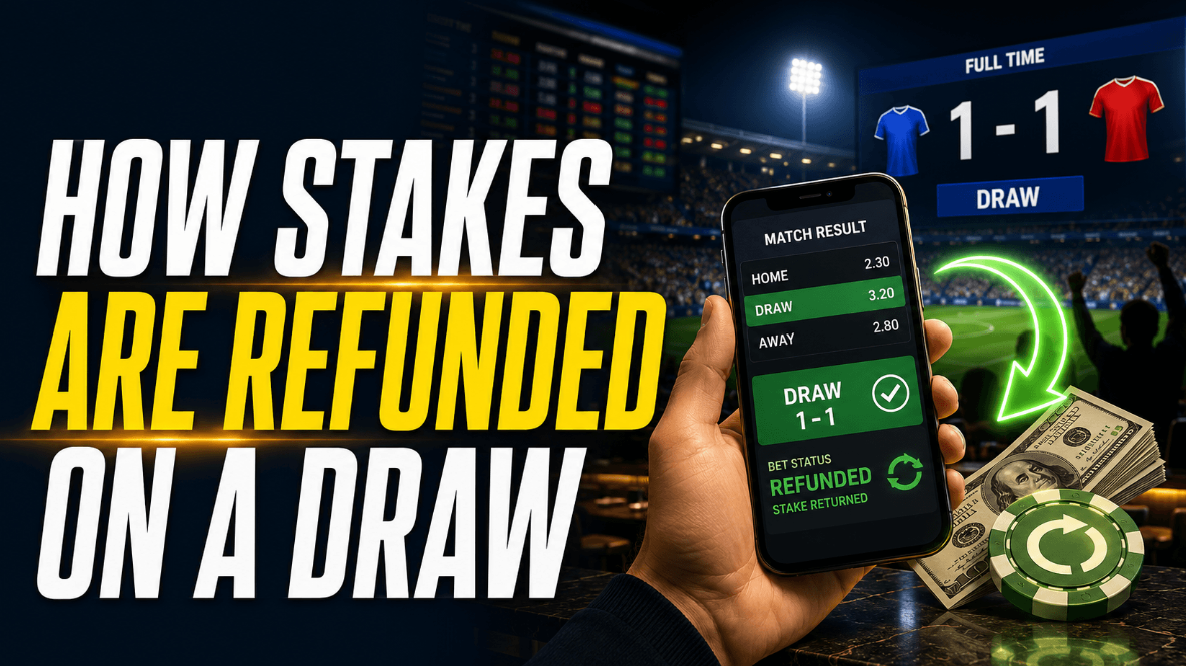
A draw result triggers a full stake refund. The bookmaker voids the bet, returns 100% of the wagered amount to the bettor's account, and records it as a push. No winnings are generated, no losses are recorded. The bettor is in exactly the same financial position as before the bet was placed.
This is the mechanism that gives DNB its value proposition: it trades a portion of potential return (lower odds than 1X2) for protection against the third outcome.
How Bookmakers Price the Draw No Bet Market
Bookmakers derive DNB odds directly from the underlying 1X2 market. The mathematical process involves redistributing the implied probability of the draw across the home and away selections. Because the draw probability is now absorbed by the two remaining outcomes, both DNB sides carry more implied probability than their 1X2 equivalents — which translates into shorter (lower) decimal odds.
The bookmaker's overround (also called juice or vig — the built-in margin that ensures a profit for the bookmaker regardless of outcome) is preserved in the conversion. DNB is not a margin-free market; the bookmaker still prices in an edge.
How Draw No Bet Odds Are Calculated
The Relationship Between 1X2 Odds and DNB Odds
To understand how DNB odds are derived, start with implied probability. Each set of odds represents a probability that the bookmaker assigns to that outcome. In a 1X2 market, three probabilities sum to more than 100% (the difference is the overround). The DNB conversion strips out the draw probability and renormalises the remaining two.
The relationship is straightforward: higher draw probability in the original 1X2 line produces a greater reduction in DNB odds relative to 1X2. A match where the draw is priced at 25% implied probability will see larger DNB compression than a match where the draw is priced at 15%.
Step-by-Step Formula: Converting 1X2 to Draw No Bet Odds
Here is the standard formula used to convert 1X2 decimal odds into DNB odds:
- Step 1: Convert each 1X2 outcome to implied probability.
- Implied probability = 1 ÷ decimal odds
- Home IP = 1 ÷ Home Odds
- Draw IP = 1 ÷ Draw Odds
- Away IP = 1 ÷ Away Odds
- Step 2: Remove the draw probability from the pool.
- Adjusted Home IP = Home IP ÷ (Home IP + Away IP)
- Adjusted Away IP = Away IP ÷ (Home IP + Away IP)
- Step 3: Convert adjusted implied probabilities back into decimal odds.
- DNB Home Odds = 1 ÷ Adjusted Home IP
- DNB Away Odds = 1 ÷ Adjusted Away IP
Note that this formula produces fair (margin-free) DNB odds from the raw 1X2 probabilities. Bookmakers apply their vig on top, so the odds you see on the platform will be slightly lower than this theoretical output.
Numeric Example: DNB Odds Calculation from a Real Match Line
Consider a Premier League fixture priced as follows:
|
Outcome
|
Decimal Odds
|
Implied Probability
|
|
Home Win
|
2.10
|
47.6%
|
|
Draw
|
3.40
|
29.4%
|
|
Away Win
|
3.60
|
27.8%
|
Step 1: Home IP = 0.476, Draw IP = 0.294, Away IP = 0.278. Total = 104.8% (the 4.8% excess is the overround).
Step 2: Remove draw. Adjusted Home IP = 0.476 ÷ (0.476 + 0.278) = 0.476 ÷ 0.754 = 0.6313. Adjusted Away IP = 0.278 ÷ 0.754 = 0.3687.
Step 3: Fair DNB Home = 1 ÷ 0.6313 = 1.58. Fair DNB Away = 1 ÷ 0.3687 = 2.71.
After the bookmaker applies margin, the live DNB odds would be approximately 1.52–1.55 (home) and 2.50–2.60 (away), depending on platform.
How Stakes Are Refunded on a Draw
Full Stake Refund Mechanics
When a match covered by a DNB bet ends in a draw, the bookmaker settles the bet as void. The precise sequence is:
- The final score is confirmed as a draw.
- The bookmaker's settlement system identifies the bet as a DNB market.
- The stake is returned in full to the bettor's account balance.
- No bonus funds, free bets, or promotional credits are applied — the return is exactly the original stake amount in real money, subject to the platform's standard wallet rules.
The void settlement is a hard rule, not a discretionary decision by the bookmaker. Any match result that is officially classified as a draw — including 0–0, 1–1, 2–2, and so on — triggers the refund automatically.
Processing Time for DNB Refunds
On most major platforms, DNB stake refunds process within minutes of the final score being confirmed. Automated settlement systems handle this without manual intervention. In rare cases involving disputed scores, VAR reviews, or abandoned-match rulings, settlement may be delayed until the governing body issues an official result. Check the bookmaker's settlement rules for specifics on postponed or abandoned matches, as DNB coverage of replayed fixtures varies by operator.
How Refunds Work in Accumulator Bets Containing DNB
This is where DNB mechanics become more complex — and where many bettors are caught off guard. If you include a DNB selection in an accumulator (parlay), a draw result on that leg does not void the entire accumulator. Instead, that specific leg is treated as void, and the accumulator continues as though the voided leg was never included.
Practically, this means:
- A 4-leg accumulator with one DNB leg that ends in a draw becomes a 3-leg accumulator.
- The potential payout is recalculated based on the remaining three legs at their original odds.
- If all remaining legs win, you are paid as a 3-leg accumulator, not the original 4-leg.
- If any non-DNB leg loses, the entire accumulator is still lost.
This void-leg mechanism also applies to promotional offers, such as the промокод 1xbet, where specific terms determine how cancelled events affect qualifying bets. The principle remains the same: a voided selection reduces the parlay rather than invalidating it entirely.
Important: Some bettors mistakenly believe a void DNB leg "saves" an accumulator. It does not change the result of other legs. If your other selections lose, the void leg provides no benefit.
Draw No Bet vs. Asian Handicap 0: Are They the Same?
Mechanical Comparison
Asian Handicap 0 (AH 0) is mathematically equivalent to Draw No Bet in terms of outcomes. Both markets cover:
- Selection wins → bet wins
- Selection loses → bet loses
- Match draws → full stake refunded
The settlement logic is identical. A draw in AH 0 is classified as a "push" — the handicap line is exactly met — which triggers the same full stake return as a DNB draw result.
Odds Differences Between DNB and AH 0
Despite identical mechanical outcomes, DNB and AH 0 often carry slightly different odds on the same match. The reason is liquidity and market positioning. Asian Handicap lines are built within a dedicated handicap pricing model with tighter spreads and higher liquidity, especially for major Asian-market bookmakers. DNB is priced from the 1X2 line with a separate conversion process.
In practice, AH 0 tends to offer marginally better value than DNB on the same fixture at Asian-focused or high-liquidity platforms. The difference is small — often 0.02–0.05 in decimal terms — but it compounds across a betting history.
When Bookmakers Offer One But Not the Other
Most large sportsbooks offer both markets for top-tier football. However, for lower-league matches, niche sports, or live (in-play) markets, one may be available while the other is not. DNB appears more frequently across a broader range of sports because it derives mechanically from any existing 1X2 line. AH 0 requires the bookmaker to maintain a dedicated handicap market, which demands more pricing infrastructure.
Draw No Bet vs. 1X2: Full Comparison
The 1X2 market (also called the full-time result or moneyline in some markets) is the standard three-outcome format: Home Win (1), Draw (X), Away Win (2). Every outcome is independently priced.
Draw No Bet gives up the possibility of backing the draw and accepts lower odds on both remaining outcomes in exchange for stake protection if the match ends level. Whether this trade is worthwhile depends entirely on your assessment of the match:
- If you believe a draw is very likely, DNB offers meaningful insurance.
- If you believe a draw is unlikely, you are paying a significant odds premium for protection you probably won't need.
- The 1X2 draw selection itself is unavailable in DNB — that line of return is permanently closed.
The core difference is this: 1X2 forces you to take a position on all three outcomes; DNB forces you to take a position on winner only, with a safety net against the neutral result.
Draw No Bet in Accumulator Bets: How It Affects the Parlay
Including DNB in an accumulator affects both the potential payout and the risk profile. Key points:
- A DNB leg with odds of 1.55 contributes less to the accumulator multiplier than the equivalent 1X2 home win odds of 2.10.
- A draw on the DNB leg voids that leg and reduces the accumulator to one fewer selection — but all other legs must still win.
- The payout on a successful accumulator containing a voided DNB leg is lower than the original projection because the multiplier is reduced.
- In system bets (e.g., Trixie, Lucky 15), a voided DNB leg is handled per the system's void rules, which vary by operator.
DNB in accumulators is most useful when you want coverage on a fixture you consider roughly 50/50 between a single side winning and drawing — but where you don't want the draw to eliminate your entire parlay ticket.
Sports and Competitions Where Draw No Bet Is Most Common
|
Sport
|
DNB Market Availability
|
Most Common Competition
|
Typical Draw Frequency
|
Bookmaker Coverage
|
|
Football (Soccer)
|
Very High
|
Premier League, Champions League, La Liga
|
25–30% of matches
|
Universal
|
|
Rugby Union
|
Moderate
|
Six Nations, Premiership
|
~5% of matches
|
Major bookmakers
|
|
Ice Hockey
|
Low
|
NHL, KHL
|
Rare (OT rules)
|
Limited
|
|
Baseball
|
Very Low
|
MLB
|
Virtually zero
|
Rare
|
|
Cricket (Test)
|
Moderate
|
International Test matches
|
~30% of Tests
|
Selected bookmakers
|
|
American Football
|
Very Low
|
NFL
|
Virtually zero
|
Rare
|
|
Basketball
|
Very Low
|
NBA, EuroLeague
|
Virtually zero
|
Rare
|
Football (soccer) is by far the dominant sport for DNB markets. The relatively high draw frequency in football — roughly one in four to one in three matches in most top leagues — makes the market commercially viable. Sports with negligible draw frequencies (NBA, NFL, MLB) rarely see DNB offered because the protection has almost no practical value.
Draw No Bet vs. Asian Handicap vs. 1X2: Comparison Table
|
Feature
|
Draw No Bet
|
Asian Handicap 0
|
1X2
|
|
Outcomes covered
|
Home Win / Away Win
|
Home Win / Away Win
|
Home Win / Draw / Away Win
|
|
Draw result
|
Stake refunded
|
Stake refunded (push)
|
Separate selectable outcome
|
|
Odds level vs 1X2
|
Lower (draw stripped out)
|
Lower (similar to DNB)
|
Full three-way odds
|
|
Market availability
|
High (football, some others)
|
High (football, primarily)
|
Universal
|
|
Accumulator compatibility
|
Yes (void leg on draw)
|
Yes (void leg on push)
|
Yes (draw loses unless backed)
|
|
Margin source
|
Derived from 1X2 line
|
Dedicated handicap pricing
|
Primary market
|
|
Best use case
|
Insurance against draw, two-sided match
|
Same as DNB, often tighter odds
|
Full outcome flexibility
|
DNB Odds Conversion Table: Example Across Different Match Scenarios
|
1X2 Home
|
1X2 Draw
|
1X2 Away
|
DNB Home
|
DNB Away
|
Home IP Shift
|
Away IP Shift
|
|
1.50
|
4.20
|
6.50
|
1.28
|
1.99
|
+63.2% → +72.2%
|
+15.4% → +26.8%
|
|
2.10
|
3.40
|
3.60
|
1.58
|
2.71
|
+47.6% → +63.1%
|
+27.8% → +36.9%
|
|
2.60
|
3.20
|
2.80
|
1.88
|
2.16
|
+38.5% → +52.2%
|
+35.7% → +47.8%
|
|
3.50
|
3.30
|
2.10
|
2.52
|
1.66
|
+28.6% → +40.8%
|
+47.6% → +59.2%
|
|
4.50
|
3.50
|
1.80
|
3.08
|
1.53
|
+22.2% → +33.0%
|
+55.6% → +67.0%
|
DNB odds are calculated using the fair-value formula (margin-free). Live bookmaker odds will be slightly lower. IP = Implied Probability.
How Implied Probability Changes When Removing the Draw
Removing the draw from the probability pool forces the two remaining outcomes to account for 100% of the bet. This is called renormalisation.
In a balanced match priced at Home 2.10 / Draw 3.40 / Away 3.60 (as in the numeric example above), the home implied probability in the raw 1X2 line is 47.6%. After removing the draw and renormalising, the home DNB implied probability rises to approximately 63.1%. The home side now carries a higher probability because the draw — a possible outcome — has been eliminated from the market's framework.
This shift is larger when the draw is more expensive (lower odds, higher probability) in the original 1X2 line. A fixture where the draw is priced at 2.50 (40% implied probability) will see a much more dramatic odds compression in DNB than one where the draw is at 5.00 (20% implied probability).
That said, this compression does not mean DNB is worse value than 1X2. It reflects what you're actually buying: a two-outcome market with a refund clause, not a three-outcome market. The probability redistribution is the fair price of the insurance.
Common Mistakes When Betting Draw No Bet Markets
Bettors consistently make the same errors with Draw No Bet. Avoiding these will improve your understanding of what you're actually wagering:
- Confusing DNB with a guaranteed hedge. DNB does not protect against a loss if your selection is beaten outright. The refund applies only on a draw. A 2–0 defeat costs the full stake.
- Expecting the same odds as 1X2. DNB odds are always lower than the equivalent 1X2 selection because the draw probability has been redistributed. If you see DNB home at 1.55 and 1X2 home at 2.10, the difference is mathematically correct — not a bookmaker error.
- Misunderstanding accumulator void mechanics. A draw on a DNB accumulator leg voids that leg, it does not refund the entire stake. Your accumulator continues at reduced legs and reduced payout.
- Using DNB on low-draw-frequency sports. Applying DNB protection in, say, an NBA game (where draws are essentially impossible) adds zero value and costs you odds. DNB is a football-first tool.
- Ignoring the DNB vs. AH 0 odds gap. If your platform offers both markets on the same fixture, always check whether AH 0 offers better odds. Mechanical equivalence does not mean price equivalence.
- Assuming refunds are instant in all cases. Settlement is automatic in most scenarios, but disputed results, abandoned matches, or technical delays can slow the process. Don't factor a fast refund into a same-day re-staking plan.
- Treating DNB as a low-risk strategy. DNB reduces one category of risk (the draw) while leaving the primary risk (outright defeat) fully intact. It is a risk-reduction tool, not a risk-elimination one.
How Bookmakers Limit or Restrict Draw No Bet Markets
Bookmakers manage their exposure on DNB markets in several ways bettors should understand:
Market suspension. DNB markets are often suspended or removed in-play more aggressively than 1X2 markets. A goal scored in the 80th minute can prompt immediate suspension while the bookmaker reassesses draw probability, leaving live bettors unable to act.
Stake limits. High-volume or consistently profitable DNB bettors may face reduced stake limits on this market type specifically. This is standard bookmaker risk management.
Availability gaps. For lower-league or international fixtures with less liquidity, DNB may not appear at all, even when the bookmaker offers 1X2 on the same match. The bookmaker requires sufficient data to price the draw probability accurately before offering the derived DNB market.
Accumulator restrictions. Some operators restrict DNB legs in certain accumulator structures or apply different void rules for system bets. Read the house rules before constructing multi-leg bets with DNB selections.
Responsible gambling reminder: all sports betting, including Draw No Bet, involves financial risk. Stake refunds on draws do not alter the fundamental risk that your selection can lose outright. Never wager amounts you cannot afford to lose, and use the responsible gambling tools available on your platform — deposit limits, self-exclusion, and time-out features — if your betting is causing concern.
FAQ
Q: Is Draw No Bet the same as backing the draw with insurance? No. DNB does not involve the draw as a winning outcome. It removes the draw entirely. If the match draws, your stake comes back — you do not profit. You are backing only a winner, with a refund safety net on the specific event of a draw.
Q: Why are DNB odds lower than the equivalent 1X2 selection? Because the draw probability from the 1X2 market has been mathematically redistributed into the two remaining outcomes. Both DNB sides carry more implied probability than their 1X2 counterparts, which means shorter odds. The reduction in odds is the price of draw protection.
Q: If a DNB leg in my accumulator draws, do I get my entire accumulator stake back? No. The drawn DNB leg is voided — removed from the accumulator — and the bet continues as a reduced-leg parlay. Your payout if all remaining legs win is calculated on the surviving legs only. The full stake is only refunded if the DNB market is the only leg in the bet.
Q: Is Asian Handicap 0 better value than Draw No Bet? Mechanically they are identical. However, AH 0 often offers marginally better odds on major football fixtures at platforms with strong Asian Handicap liquidity. Always compare both markets before placing. The difference is typically small (0.02–0.05 decimal) but consistent.
Q: Does DNB apply to extra time results? Standard Draw No Bet markets are settled on 90 minutes (plus stoppage time) only. If a match goes to extra time, the 90-minute result determines settlement regardless of what happens in additional periods. A 1–1 score at 90 minutes triggers the refund even if the match later goes to extra time or penalties. Check the specific settlement rules on your platform to confirm.
Q: Can I use DNB on in-play (live) betting? Many bookmakers offer DNB in-play, but the market is often suspended more frequently than 1X2 during live action — particularly following goals or red cards. Availability depends on the platform and the specific fixture.
Q: How do I calculate fair DNB odds from a 1X2 line myself? Take the home and away 1X2 prices, convert them to implied probabilities (1 ÷ odds), add them together, then divide each individual probability by that sum. Convert back to decimal odds. This gives you the fair-value DNB price. Apply a 3–5% reduction to estimate what the bookmaker will actually offer after margin.